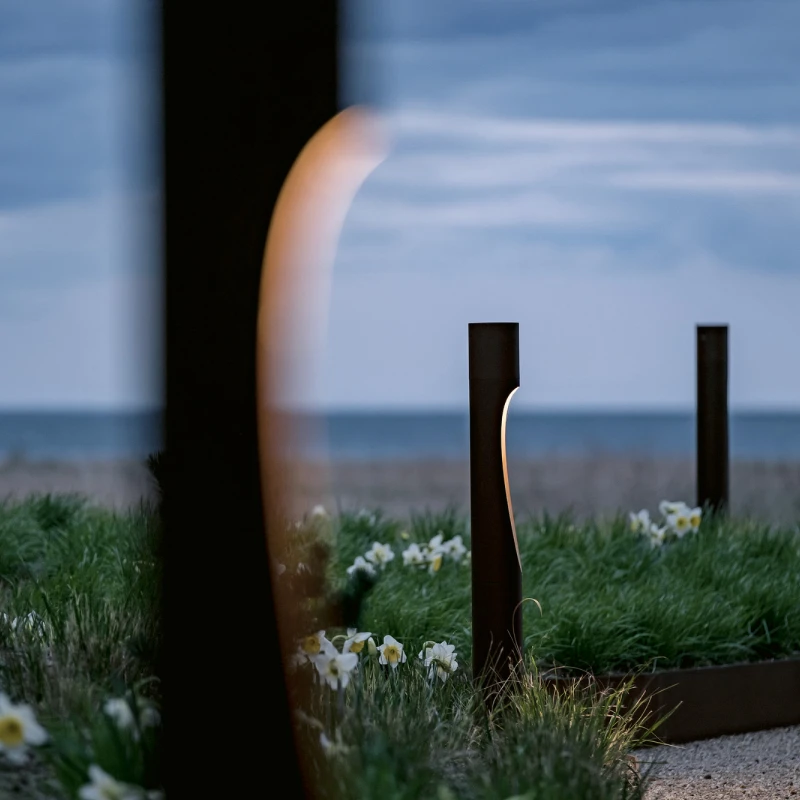
What is path lighting?
Path lights are a core part of landscape lighting. Like your indoor lighting scheme, your outdoor path lighting should be layered with ambient, accent, and task lights to create balance and depth. Functional lighting like path lighting is ideal for high-traffic areas where high visibility is needed. However, choosing the right bulbs, angles, and spacing for outdoor path lighting fixtures can add to the overall ambient lighting and atmosphere of your outdoor space.
Why path lighting matters (safety + ambiance)
A well-lit pathway can elevate your outdoor space. An outdoor gathering or an evening walk is made better with warm lighting. Cohesive landscape path lighting helps your outdoor space feel like a continuation of your indoor space.
Path lights improve more than the view of your outdoor space. They increase safety. Walking a well-lit pathway at night significantly reduces falls, improves visibility, and provides home security.
Where to place path lights
For both aesthetic appeal and safety, path lighting placement matters. When installing path lights, avoid the runway look of placing lights close together on both sides of the path. This throws off the balance and adds too much light to the path. Overly bright lights appear harsh. Instead, create a calming look by alternating lights on either side. Place lights where the pathway transitions, such as from driveway to stairs. Aim the lights downward and avoid lighting your neighbors' lawn.
When you decide where to place your path lights, also consider the wiring. Conceal all wires and place the transformer in a discreet location. The transformer needs to be easily accessible for maintenance and not affect the aesthetics.
Spacing and height guidelines
Generally, path lights should be about 5 to 8 feet apart. However, the spacing should be adjusted depending on the type of light you choose. Because lighting from each fixture may create circular or forward patterns, test the lights at night to find the ideal location for each fixture.
In addition to spacing between each path lighting fixture, place the lights at the ideal distance from the path. This distance is easy to estimate using guidelines from lighting designer Nels Peterson: Measure the light’s height and place the light the same distance from the path. For a 13-inch light, place the lamp 13 inches from the path.
Another placement option is to install landscape path lighting in nearby flower beds for an interesting, yet functional design. Thoughtfully pairing plants with nearby lights can soften path lighting that would appear harsh on its own. The combination can also cast delicate shadows across the path for beautiful details at night while retaining visibility.
Path lighting styles: Bollards, in-ground, and spotlights
The most common type of path lighting is bollard lights, which are mounted on stakes and easy to install. They light paths by projecting light downward. While primarily used to illuminate a pathway, they help highlight obstacles for safer navigation at night.
For subtle path lighting that cohesively integrates with modern architecture, consider in-ground path lighting. These low-profile lights integrate into the pathway and are ideal for minimalist landscaping.
Not all path lighting is installed as in-ground path lighting. Another landscape path lighting solution uses spotlights. These are often placed discreetly in trees or other structures and aimed down toward a path. At an ideal distance, spotlights produce a soft, moonlight effect. These are best suited to long pathways.
Choosing Glare-Free, Dark Sky-Friendly Path Lighting
DarkSky International and the Illuminating Engineering Society offer five principles for dark-sky friendly path lighting that is aesthetically pleasing and minimizes light pollution:
- Only use the necessary number of lights to minimize impact on wildlife and light pollution.
- Aim your lights to only illuminate the areas where they are needed.
- Keep lights only as bright as needed. This also helps avoid distracting reflections and glare.
- Turn on your lights only when you need to. Timers, dimmer switches, and motion detectors can help ensure your lights are on only when necessary.
- Choose warm-toned lights over blue-toned lights where possible.
To comply with DarkSky recommendations, pay attention to lumens and color temperature of your fixtures. Brighter is not necessarily better. Brighter bulbs create light pollution and create glare that reduces visibility.
Experts consider ideal warm outdoor lights to be 2700K, and all path lighting should be below 3000K2. The bulbs appear cozy without looking too red-toned and still provide plenty of visibility. For brightness, choose lower lumen options. Paths can be illuminated with 200 or fewer lumens, so aim for 100 to 200 lumens.
LED and halogen bulbs are both appropriate for outdoor fixtures, but LED path lighting is more energy-efficient. Solar lights may be tempting as they are cost-effective and environmentally friendly, but they come with downsides. Solar lights don’t last as long as electric lights, and most solar lights are above the 3000K temperature recommended for path lighting.
Louis Poulsen’s Approach to Path Lighting
Beyond function, outdoor lighting is an art. Louis Poulsen's designs extend beauty from your home into your entrance and garden. Our practical lighting fixtures bring timeless simplicity, transforming outdoors into a living space of its own. To elevate your home, explore Louis Poulsen’s collection of glare-free outdoor bollards and garden lights.
FAQ
What is a path light used for?
Path lighting improves the ambience and safety of your outdoor space. As part of a layered lighting plan, they provide depth and balance to your landscaping. Path lighting creates safe navigation at night while offering aesthetic appeal.
How far apart should path lights be spaced?
Generally, path lights work best placed about 5 to 8 feet apart. Also, placement on either side of the path is important. Instead of placing path lighting parallel, alternate placing them on either side to avoid an overly harsh runway look.
How tall should path lighting be?
Path lighting varies in height, ranging from in-ground lights to spotlights placed in nearby trees. Instead of choosing a specific height, consider how far they are placed from the path to create a balanced look. For bollard lights, measure their height and place them that distance from the path. For spotlights, adjust their placement so they don’t spill into your neighbor's yard and aim them directly toward your path.
What’s the difference between a bollard light and an in-ground path light?
Bollard lights are one of the most common types of path lighting. These are path lights that come attached to a short post and can be placed in the ground near the path. They have a traditional appeal and can be considered part of your outdoor decorations. For homes with a more modern and minimal aesthetic, in-ground path lighting is ideal. They have a subtle look that sits flush with the path.
Can path lighting be dark sky compliant?
DarkSky International suggests five ways to keep your path lighting dark sky compliant. Path lights should use only the necessary number of lights, aim them in the direction where needed, avoid overly bright lights, turn on only when needed, and use warm-toned bulbs. By combining these suggestions, your outdoor space will feel cozy, safe to navigate, and create minimal noise pollution.
How many lumens do I need for path lighting?
Lumens should be kept to a minimum for path lighting. Bulbs that are too bright create harsh light and glare that makes navigating at night difficult. The ideal brightness is between 100 and 200 lumens.
Sources:
- DiLouie, C. (14 June 2024). Landscape Lighting Guidance: Considerations when creating an outdoor space. Electrical Contractor Magazine. Retrieved October 16, 2026, from https://www.ecmag.com/magazine/articles/article-detail/landscape-lighting-guidance-considerations-when-creating-an-outdoor-space
- David, A. (4 August 2024). How to light a garden path – tips from lighting designers. Homes and Gardens. Retrieved October 16, 2026, from https://www.homesandgardens.com/gardens/how-to-light-a-garden-path
- Raymond, C. (27 May 2026). All About Path Lighting. This Old House. Retrieved October 16, 2026, from https://www.thisoldhouse.com/lighting/all-about-path-lighting
- (September 2026). Five Principles for Responsible Outdoor Lighting. DarkSky International. Retrieved October 16, 2026, from https://darksky.org/resources/guides-and-how-tos/lighting-principles/